Manufacturing in the UAE is becoming more digital, connected, and data-driven. Factories need to control materials, production orders, machines, workers, quality checks, warehouses, and delivery timelines. Spreadsheets and disconnected tools often cannot support this work for long.
This is where UAE manufacturing software helps. It gives manufacturers one system, or a connected set of systems, to plan production, track shop floor activity, manage inventory, control costs, and make better decisions.
The right system depends on the company size, production type, number of sites, and level of automation. A small food producer may need inventory, batch tracking, purchase planning, and sales order control. A larger industrial plant may need ERP, MES, IoT data, machine monitoring, predictive maintenance, and advanced manufacturing analytics.
This guide explains manufacturing software in plain language. It covers ERP, MES, automation tools, key features, UAE-specific selection criteria, vendor options, implementation risks, and ROI. It is written for business owners, plant managers, production engineers, and IT leaders who need to choose the best manufacturing software in the UAE.
- What Is Manufacturing Software in the UAE Context
- UAE Manufacturing and Digitization Trends
- Key Selection Criteria for UAE Manufacturing Software
- UAE Manufacturing Software Vendors Compared
- Implementation Best Practices and Pitfalls in the UAE
- ROI and Business Justification for UAE Manufacturers
- Roadmap and Next Steps to Select and Deploy UAE Manufacturing Software
- To Sum It Up
- Frequently Asked Questions About UAE Manufacturing Software
- List of Resources
What Is Manufacturing Software in the UAE Context
Manufacturing software helps a factory plan, run, and control production. It connects customer orders, raw materials, BOMs, work orders, machines, workers, quality checks, finished goods, and costs.
In the UAE, this software often needs to support imported raw materials, export orders, several warehouses, VAT records, multi-currency purchases, and fast delivery across different emirates.
For a small or mid-sized factory, manufacturing software may start with a cloud ERP system. The business uses it to manage inventory, bills of materials, production orders, purchases, sales, suppliers, customers, and reports.
For a larger plant, the stack may also include MES. MES means Manufacturing Execution System. It focuses on what happens on the shop floor right now: which job is in progress, which machine is running, who completed an operation, how much material was used, and how many units passed quality control.
Some manufacturers also add IoT, barcode scanners, maintenance systems, or automation modules. These tools collect live data from machines, workers, and warehouse operations.
Core Modules and Capabilities
Most UAE manufacturing software includes production planning, BOM management, shop floor control, inventory and materials management, quality control, maintenance scheduling, and analytics dashboards.
These modules help teams plan what to produce, reserve the right materials, track work in progress, record defects, maintain machines, and monitor production KPIs.
ERP vs MES vs Automation and IoT Modules
ERP manages the business side of manufacturing: sales, purchases, inventory, production orders, finance, suppliers, and customers.
MES manages shop floor execution: machine status, labor, operations, downtime, output, and quality checks.
IoT and automation tools collect live data from machines, sensors, scanners, and connected devices.
Many UAE manufacturers do not need all these tools at once. A growing SME may start with cloud manufacturing ERP software and add MES or IoT later.
| System Type | Main Purpose | Best For |
Plan and manage business operations |
Sales, purchasing, inventory, production, finance |
|
MES |
Control shop floor execution |
Machines, labor, WIP, quality, downtime |
IoT / automation |
Collect live factory data |
Sensors, machine monitoring, predictive maintenance |
Analytics |
Turn data into reports |
KPIs, costs, output, trends |
UAE Manufacturing and Digitization Trends
The UAE is investing in manufacturing as part of its long-term economic strategy. The goal is not only to produce more goods locally. The country also wants to build smarter, more competitive, and more export-ready factories.
This creates stronger demand for UAE manufacturing software. Manufacturers need better control over production, materials, quality, costs, delivery dates, and compliance records.
According to Grand View Research / Horizon, the UAE smart manufacturing market generated USD 3,241.2 million in 2025 and is projected to reach USD 7,798.5 million by 2033. The expected CAGR is 11% for 2026–2033. The same source names software as the largest and fastest-growing component segment.
UAE Manufacturing Sectors and Growth Drivers
Manufacturing in the UAE covers many sectors. Key areas include food and beverages, aerospace, fabricated metals, maritime manufacturing, machinery and equipment, pharmaceuticals, chemicals, construction materials, packaging, and consumer goods.
These sectors often work with imported raw materials, strict delivery timelines, multiple warehouses, and regional or global customers. This makes production planning harder. A delay in one material can stop a full work order. A wrong batch record can create quality or compliance risks.
Manufacturing software helps reduce these risks. It connects sales demand, stock levels, purchase orders, production plans, and finished goods in one workflow.
Government and Industry 4.0 Push
The UAE’s industrial strategy supports advanced manufacturing, automation, and digital transformation. Operation 300bn and UAE Industry 4.0 encourage factories to improve productivity, adopt advanced technology, and build stronger industrial capabilities.
For manufacturers, this means software is becoming part of the basic factory infrastructure. ERP, MES, IoT, analytics dashboards, and workflow automation help companies move away from manual tracking and delayed reporting.
A factory does not need to become fully automated at once. Many companies start with inventory, production orders, BOMs, purchasing, and simple dashboards. Later, they add machine monitoring, predictive maintenance, barcode scanning, or MES.
Digital Transformation Challenges in UAE Manufacturing
Digital transformation is not only a software purchase. Many UAE manufacturers still deal with disconnected spreadsheets, legacy accounting systems, manual stock counts, and production updates shared through messages or paper forms.
The main challenges are usually integration, clean data, staff training, and cost control. A new system must connect with existing tools, support Arabic and English users when needed, and work across emirates, warehouses, or free zone and mainland operations.
This is why the best manufacturing software in the UAE is not always the largest system. It is the system that fits the factory’s real workflow and can scale step by step.
UAE Manufacturing Software Market Snapshot
| Trend | What it means for factories |
Industry 4.0 adoption |
More need for automation, analytics, and machine data |
Multi-site operations |
Better demand for cloud manufacturing software UAE |
Import and export activity |
Stronger need for traceability and document control |
Cost pressure |
More focus on waste, downtime, and material planning |
Skills gap |
Systems must be simple, visual, and easy to train |
Key Selection Criteria for UAE Manufacturing Software
The best manufacturing software in the UAE is not always the system with the longest feature list. It is the system that fits your factory, your team, your compliance needs, and your growth plans.
Before comparing vendors, identify your biggest challenge. Do you need better production planning? More accurate inventory? Batch traceability? Lower downtime? Faster reporting? Your answer will determine which features matter most.
Local Compliance and Reporting
The software should support UAE VAT records, inventory valuation, production costs, and complete audit trails. For regulated industries such as food, pharmaceuticals, and chemicals, it should also provide batch or serial traceability and quality records.
Multi-Site and Multi-Currency Operations
Many UAE manufacturers manage several warehouses, production sites, or companies. If you buy materials globally or sell internationally, the system should support multiple locations, currencies, and user permissions without duplicate data.
Cloud, On-Premise, or Hybrid
Cloud manufacturing software suits most SMEs because it requires less IT infrastructure, receives automatic updates, and allows managers to access production data remotely. Larger manufacturers with strict security or operational requirements may prefer on-premise or hybrid deployment.
Integration Capabilities
Manufacturing software should connect with accounting, CRM, warehouse systems, logistics providers, e-commerce platforms, and production equipment. If MES or IoT tools are added later, integration should not require rebuilding the entire system. Solutions such as Kladana can also act as an integration layer to keep data consistent across ERP, inventory, sales, and connected business systems.
Scalability and Vendor Support
Your requirements will change as production grows. Choose software that allows new modules, users, warehouses, or production lines without replacing the entire system. Local implementation experience and responsive support are equally important.
Total Cost of Ownership
Look beyond the subscription price. Include implementation, customization, integrations, training, maintenance, and future upgrades. A system with a higher initial cost may deliver better ROI if it reduces manual work, production delays, inventory errors, and downtime.
| Evaluate | Questions to Ask |
Production |
Does it support your manufacturing process? |
Inventory |
Can it track raw materials, WIP, and finished goods? |
Integration |
Does it connect with your existing software? |
Growth |
Will it support more users, sites, and production lines? |
Support |
Is implementation and local support available? |
Cost |
What is the total cost over the next 3–5 years? |
Make shop floor work visible in real time
Kladana helps managers assign tasks to workers and track each production stage step by step. Shop floor teams receive clear tasks, mark operations as completed, and record progress in the app.
Managers can monitor deadlines, job cards, WIP, task completion, and worker assignments without waiting for manual updates at the end of the shift.
UAE Manufacturing Software Vendors Compared
The UAE market includes local ERP vendors, regional implementation partners, and global platforms used by manufacturers. Some systems focus on full ERP. Others focus more on production, inventory, shop floor tracking, or analytics.
This comparison is a starting point for shortlisting. Always check demos, implementation scope, local support, and integration needs before choosing a vendor.
| Vendor / Solution | Best For | Strong Points | Watch Out For |
BizCentric |
Companies that need simple production tracking and quality checks |
Quality management, production tracking, real-time reporting |
Check depth of MRP, BOM, MES, and integration options |
EBR Software |
Manufacturers that need broad ERP modules |
MRP, BOM, shop floor control, quality, maintenance, traceability, multi-location management |
May need detailed scoping for customization and implementation |
SowaanERP |
UAE firms that need localized ERP |
UAE customization, VAT support, logistics interfaces, multi-currency operations |
Confirm manufacturing depth for your process type |
PACT / PACT REVENU |
Growing manufacturers with multi-site needs |
Production scheduling, BOM, inventory, quality control, reporting, multi-site production |
Confirm MES, IoT, and machine-level integration capabilities if needed |
Euclidz |
Manufacturers that need shop floor visibility |
Planning, scheduling, work center control, maintenance, quality checks, performance data, multi-warehouse inventory |
Check implementation scope and fit for smaller SMEs |
TrueBays / StackFX |
UAE SMEs that need localized manufacturing ERP |
BOM, MRP, warehouse operations, work orders, cost management, production control, UAE compliance features |
Confirm fit for complex plant-level MES or advanced IoT needs |
ZYNO / Elite Mindz |
Companies comparing cloud manufacturing ERP options |
Real-time production monitoring, centralized data, scalable planning, automated workflow and reporting |
Validate UAE implementation references and manufacturing depth |
SAP Business One |
Mid-sized firms with complex operations |
Strong ERP base, BOM support, partner ecosystem |
Cost and implementation effort can be higher |
Oracle NetSuite |
Multi-entity or international manufacturers |
Cloud ERP, work orders, routing, WIP, scalability |
May be too complex for smaller factories |
Odoo |
SMEs that need modular flexibility |
Manufacturing orders, BOMs, work orders, shop floor control panel, IoT options |
Requires strong implementation control |
SMEs that need connected production and inventory |
BOMs, routings, production orders, Shop Floor App, costing, WIP, scrap, MRP, inventory and sales integration |
Best for practical ERP-based production control, not heavy machine-level MES |
Strengths and Drawbacks in the UAE Context
Local vendors often understand UAE VAT, Arabic and English use cases, local support expectations, and regional business processes. This can make implementation easier for SMEs.
Global ERP systems can offer stronger scalability, reporting, and partner ecosystems. They may suit larger manufacturers with several entities, countries, or complex finance needs.
Cloud manufacturing software is often the easiest starting point for SMEs. It reduces infrastructure work and helps managers access data across warehouses, offices, and production sites.
A manufacturer that already uses several tools may need an integration layer. Kladana can help connect production, inventory, sales, purchasing, and external systems so teams work with consistent data instead of duplicate spreadsheets.
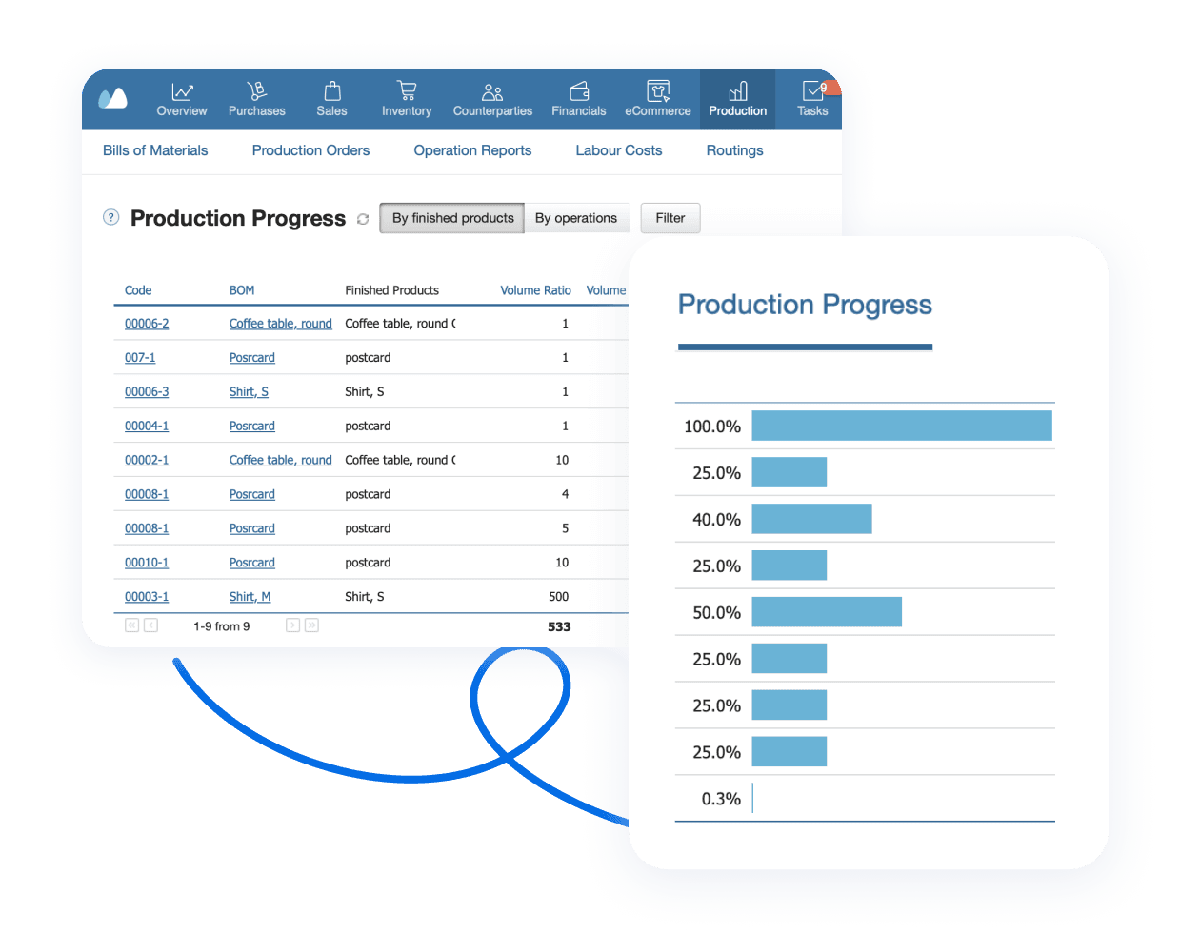
Kladana production module overview
Implementation Best Practices and Pitfalls in the UAE
A manufacturing software project can fail even when the system itself is good. The usual reasons are unclear goals, poor data, weak training, and underestimated integration work.
The safest approach is to implement the system in stages. Start with the process that creates the most pain: inventory accuracy, production planning, BOM control, purchasing, or shop floor reporting.
Use a Phased Rollout
Do not move every workflow at once unless your team is ready. Start with a pilot site, one production line, or one product group. Test how the system handles real orders, materials, production steps, waste, and quality checks.
After the pilot, fix process gaps before rolling the system out across all plants, warehouses, or emirates.
Clean Data Before Migration
Bad data creates bad results. Before migration, check item names, units of measure, BOMs, supplier records, customer records, stock balances, and open orders.
This step is especially important for UAE manufacturers that buy materials in several currencies or manage stock across free zones, mainland facilities, and export workflows.
Plan Integrations Early
Manufacturing software often needs to connect with accounting, CRM, e-commerce, logistics, warehouse tools, MES, barcode scanners, or IoT systems. If integration is planned too late, teams may return to manual exports and duplicate data entry.
Middleware or connector layers can reduce this risk. For example, Kladana can help keep inventory, production, sales, purchasing, and connected systems aligned so teams do not work with conflicting numbers.
Train Users by Role
A plant manager, accountant, warehouse worker, and production operator do not need the same training. Create short role-based training sessions. Use real examples: create a work order, issue materials, complete production, record waste, run a quality check, or update stock.
Simple training improves adoption and reduces mistakes after go-live.
Test Before Go-Live
Before launch, test the full workflow. A sales order should create demand. Materials should be reserved. Production should update WIP and finished goods. Quality checks should be recorded. Costs and stock values should update correctly.
Also prepare a fallback plan. If something fails during go-live, the team should know how to keep production running and how to correct data later.
| Pitfall | Better Approach |
Launching all modules at once |
Start with a pilot workflow |
Migrating messy data |
Clean master data first |
Ignoring integrations |
Map connected systems early |
Training everyone the same way |
Train users by role |
No go-live backup plan |
Prepare fallback steps |
ROI and Business Justification for UAE Manufacturers
Software investment also fits a wider UAE industrial investment trend. In 2024, AED 9.5 billion in financing was allocated to the UAE industrial sector, including AED 1.1 billion for advanced technology, the UAE Ministry of Industry and Advanced Technology reports.
This does not mean every manufacturer needs a large digital transformation project. It means technology investment is becoming a normal part of industrial growth. For SMEs, the business case can start with practical goals: fewer stock errors, lower waste, faster planning, better traceability, and less manual reporting.
Main Cost Drivers
The total cost of UAE manufacturing software may include licenses, implementation, data migration, customization, integrations, training, support, and future upgrades.
Cloud manufacturing software usually has a lower starting cost because the company does not need to buy and maintain its own servers. On-premise or hybrid systems may cost more at the beginning, but they can suit larger plants with strict control or security needs.
A realistic budget should also include internal time. Managers, accountants, warehouse workers, and production teams need to help clean data, test workflows, and learn the system.
Main Benefit Drivers
The main benefits usually come from better control over materials, production time, quality, and downtime.
For example, software can help reduce excess stock, prevent material shortages, improve production scheduling, lower defect rates, track machine maintenance, and reduce manual reporting.
These benefits are often easier to measure than broad “digital transformation” claims. Good ROI metrics include inventory reduction, fewer urgent purchases, lower scrap, shorter production delays, faster order fulfillment, and fewer hours spent on manual reports.
Simple Payback Example
Here is a simplified estimate for a UAE SME manufacturer.
| Item | Example Estimate |
Annual manufacturing-related operating cost |
AED 2,000,000 |
Software and implementation cost, first year |
AED 180,000 |
Inventory and waste reduction |
AED 90,000 |
Labor time saved |
AED 45,000 |
Fewer delays and urgent purchases |
AED 55,000 |
Estimated annual benefit |
AED 190,000 |
Estimated payback |
About 12 months |
This is not a guaranteed result. A factory with poor data, weak adoption, or complex integrations may need longer to see ROI. A factory with high stock errors, frequent downtime, or manual planning may see faster gains.
The best way to build a business case is to measure your current baseline first. Track stock accuracy, downtime, defect rate, planning time, delayed orders, and manual reporting hours. Then compare these numbers after implementation.
Roadmap and Next Steps to Select and Deploy UAE Manufacturing Software
Choosing manufacturing software is easier when the process is structured. Do not start with vendor demos. Start with your own factory needs, current problems, and target results.
Step 1: Build a Shortlist
Create a shortlist of 3–5 vendors. Include local UAE manufacturing software providers, regional ERP partners, and global ERP or MES systems if your operations are complex.
Compare each option against your real workflow: production planning, BOMs, inventory, purchasing, quality checks, maintenance, reporting, integrations, and multi-site support.
Step 2: Prepare an RFP or Evaluation Checklist
A simple RFP helps vendors answer the same questions. Ask about supported manufacturing types, UAE compliance features, cloud or on-premise options, implementation timeline, integration experience, support terms, and total cost.
Also ask which features are standard and which require customization. This helps avoid cost surprises later.
Step 3: Run a Pilot or Proof of Concept
Before full deployment, test the system with real data. Use one product group, one production line, or one warehouse.
The pilot should cover a full workflow: sales demand, material planning, purchasing, work order creation, production completion, quality check, stock update, and reporting.
Step 4: Check Integration Readiness
List all systems that must connect with the new software. This may include accounting, CRM, e-commerce, logistics, warehouse tools, barcode scanners, MES, IoT devices, or spreadsheets that still contain important data.
If several tools must work together, consider an integration layer. Kladana can help connect production, inventory, sales, purchasing, and external systems so teams work with the same operational data.
Step 5: Scale and Benchmark
After go-live, measure results against your baseline. Track stock accuracy, delayed orders, material shortages, downtime, defect rate, production lead time, and manual reporting hours.
Then expand step by step. Add more users, warehouses, production lines, dashboards, or automation modules only after the core workflow is stable.
| Selection Stage | Main Output |
Needs review |
Clear list of factory problems |
Vendor shortlist |
3–5 suitable systems |
RFP |
Comparable vendor answers |
Pilot |
Tested workflow with real data |
Integration plan |
Connected systems mapped |
Rollout |
Phased launch and KPI tracking |
Know what each product really costs
Kladana calculates product costs using raw materials, operations, and labour costs. You can also record scrap, by-products, quality checks, subcontractor operations, and partial manufacturing.
This gives manufacturers clearer control over margins, waste, production deviations, and finished goods. It also helps teams understand where costs grow and where processes need attention.
To Sum It Up
UAE manufacturing software helps factories move away from spreadsheets, delayed reports, and disconnected tools. It connects production planning, inventory, purchasing, shop floor activity, quality control, maintenance, and reporting in one workflow.
The right system depends on the factory’s size and process. A small or mid-sized manufacturer may start with cloud manufacturing ERP software to manage BOMs, work orders, stock, purchases, and sales. A larger plant may need ERP + MES integration, machine data, IoT, predictive maintenance, and advanced analytics.
For UAE manufacturers, local fit matters. The software should support multi-site operations, imported materials, export workflows, UAE VAT records, multi-currency purchases, and users across different emirates or free zone and mainland locations.
Do not choose software only by feature list. Start with the main business problem: poor stock accuracy, weak production planning, high waste, downtime, delayed orders, or lack of traceability. Then compare vendors by workflow fit, integration options, support, scalability, and total cost of ownership.
The safest path is a phased rollout. Clean your data, run a pilot, test integrations, train users by role, and measure KPIs after go-live. Once the core workflow is stable, the company can add MES, IoT, automation, or advanced dashboards step by step.
The best manufacturing software in the UAE is the system that gives the factory clear data, fewer manual errors, better cost control, and room to grow.
📚 Recommended Reads
Want to explore the topic further? These guides may help:
Manufacturing ERP 2026: Best for Production and Inventory — learn how ERP connects production, inventory, purchasing, and reporting.
Inventory Management for Manufacturing: Basics, Challenges, and Best Practices — see how manufacturers can track raw materials, WIP, finished goods, and stock movements.
Warehouse Management System in the UAE — explore how WMS helps UAE businesses manage warehouses, fulfillment, and stock accuracy.
Frequently Asked Questions About UAE Manufacturing Software
Manufacturing software can mean different things depending on the factory size, process type, and level of automation. These answers cover the most common questions UAE manufacturers ask before choosing ERP, MES, or connected production tools.
What is manufacturing software or MES for UAE factories?
Manufacturing software helps factories plan, run, and control production. It can cover materials, BOMs, work orders, inventory, quality checks, maintenance, and reporting. MES, or Manufacturing Execution System, focuses more on shop floor activity. It tracks what happens during production: machine status, operations, downtime, labor, output, and defects.
How does manufacturing software differ from general ERP?
General ERP manages business operations such as sales, purchases, finance, inventory, and reporting. Manufacturing software adds production-specific features. These may include BOMs, routing, production planning, WIP tracking, quality control, batch or serial traceability, and shop floor control. Some ERP systems include manufacturing modules, while larger factories may also need a separate MES.
Which vendors offer manufacturing software in the UAE?
UAE manufacturers can compare local and regional vendors such as BizCentric, EBR Software, SowaanERP, PACTSoft, and other UAE ERP providers. They can also consider global systems such as SAP Business One, Oracle NetSuite, Odoo, and Microsoft-based solutions through local partners. Kladana can suit SMEs that need connected inventory, production, purchasing, sales, and integrations in one workflow.
What is the cost range for manufacturing software in the UAE?
The cost depends on users, modules, deployment model, customization, integrations, training, and support. A small cloud ERP setup may start with a lower monthly or annual subscription. A larger ERP + MES project can require a higher implementation budget. Always calculate total cost of ownership, not only the license price. Include migration, setup, support, and future changes.
How long does implementation take in the UAE context?
A simple cloud manufacturing ERP setup may take a few weeks. A more complex project with several sites, custom workflows, integrations, and MES features may take several months. The timeline depends on data quality, team availability, process complexity, and vendor support. A phased rollout is usually safer than launching every module at once.
Can manufacturing software handle multi-plant operations across emirates?
Yes, many systems support multiple warehouses, production sites, branches, companies, or user roles. This is useful for manufacturers that operate across Dubai, Abu Dhabi, Sharjah, Ajman, or free zone and mainland locations. Before choosing a vendor, check whether multi-site stock, transfers, permissions, reporting, and costing work in the standard version or need customization.
How can manufacturing software integrate with IoT, sensors, machines, or PLCs?
Integration depends on the system and equipment. Some MES platforms can connect directly with machines, PLCs, sensors, and industrial devices. ERP systems may need connectors, APIs, middleware, or a separate MES layer. Start by mapping the machines, data points, and workflows you need. Then check if the vendor has similar integration experience.
What are common pitfalls in UAE manufacturing software deployments?
Common pitfalls include unclear goals, messy master data, weak user training, underestimated integration work, and too much customization too early. Another risk is choosing software based only on a demo. The system should be tested with real BOMs, stock data, production orders, quality checks, and reports before full rollout.
What ROI can UAE manufacturers expect?
ROI depends on the current level of waste, downtime, stock errors, manual work, and production delays. Benefits may include lower inventory costs, fewer urgent purchases, better machine use, faster reporting, and improved order fulfillment. To measure ROI, track baseline KPIs before implementation, then compare results after go-live.
What future trends should UAE manufacturers watch?
Important trends include AI-assisted planning, predictive maintenance, IoT-based machine monitoring, digital twins, robotics, low-code workflows, and advanced manufacturing analytics. SMEs should not start with every trend at once. The best first step is a clean digital base: accurate inventory, BOMs, production orders, quality records, and useful dashboards.
List of Resources
- Grand View Research / Horizon — UAE Smart Manufacturing Market Size & Outlook, 2026–2033
- the UAE Ministry of Industry and Advanced Technology — UAE industrial sector: Cornerstone of sustainable economic growth