If you run a manufacturing business in Malaysia, you already understand how important technology has become for staying competitive. From Penang to Johor, factories are moving from manual processes to digital systems that connect every part of production.
Modern manufacturing software in Malaysia helps you manage inventory, track production, monitor quality, and plan resources in real time. With the rise of Industry 4.0 and cloud adoption, more SMEs are choosing ERP and MES software to improve efficiency and meet local regulations.
Malaysia’s tech ecosystem is expanding rapidly, creating a strong foundation for digital manufacturing. According to the Mordor Intelligence report, Malaysia’s ICT market alone is projected to touch $28.65 billion in 2025 and grow further to $45.32 billion by 2030, reflecting how fast local industries are investing in connected systems and automation.
This guide helps you understand what manufacturing software really does, how it fits into Malaysia’s manufacturing landscape, and what features you should look for before investing, and understand how local businesses are using ERP for manufacturers in Malaysia.
- What Is Manufacturing Software (ERP/MES)?
- Core Modules of Manufacturing Software
- Differences & Overlaps: ERP vs MES cs Shop Floor Automation
- Why Modern Manufacturing Software Matters In Malaysia
- Key Criteria for Choosing Manufacturing in Malaysia
- Comparison of Top Malaysia / Regional Vendors & Solutions
- Implementation Best Practices & Pitfalls
- Malaysian Case Studies & Success Stories
- ROI & Business Justification for Malaysia
- Future Trends for Manufacturing Software in Malaysia
- Actionable Roadmap & Next Steps
- Frequently Asked Questions on Manufacturing Software in Malaysia
- List of Resources
What Is Manufacturing Software (ERP/MES)?
Manufacturing software refers to integrated ERP and MES (Manufacturing Execution System solutions) designed to manage production from order to delivery. These systems link key functions such as inventory management, production scheduling, quality control, and performance analysis, allowing you to operate with complete visibility and control across your factory.
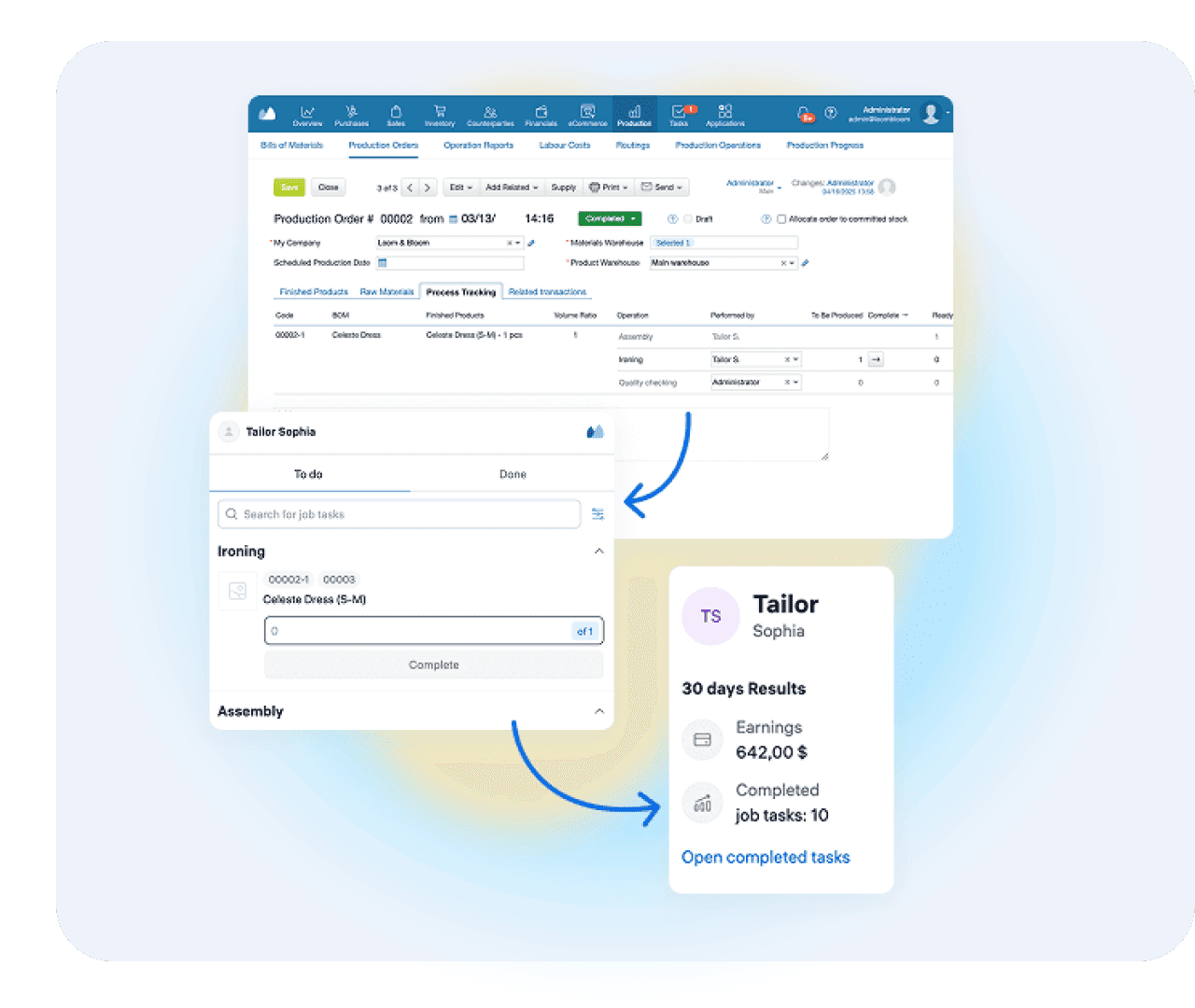
Core Modules of Manufacturing Software
Most ERP and MES systems for manufacturers in Malaysia include modules that handle both planning and execution. Together, they form the backbone of your production workflow.
| Module | What It Does | Why It Matters |
| Inventory management | Tracks raw materials, semi-finished goods, and finished products | Prevents stockouts and overstockouts while improving cash flow |
| Production planning & scheduling | Converts sales forecasts into work orders and optimizes production timelines | Helps balance workloads and meet delivery deadlines |
| Quality management | Records inspections, rejects, and compliance data | Reduces defects and ensures product consistency |
| Maintenance management | Plans preventive and corrective maintenance for machines | Minimizes unexpected downtime and extends equipment life |
| Reporting & analytics | Converts production and cost data into actionable insights | Improves decision-making and long-term planning |
Differences & Overlaps: ERP vs MES cs Shop Floor Automation
To choose the right mix of systems, it helps to understand how ERP, MES, and shop floor automation differ — and where they overlap. This table breaks down each layer by purpose, scope, and integration flow.
| Aspect | ERP | MES | Shop Floor Automation |
| Main purpose | Business-wide resource and process planning | Real-time control and tracking of production | Machine-level automation and data capture |
| Focus level | Company/management layer | Plant/production line layer | Equipment/process layer |
| Data type | Transactional and financial data | Operational, performance data, and OEE (Overall Equipment Effectiveness | Machine and sensor data |
| Key functions | Inventory, procurement, costing, HR, finance | Work orders, production, tracking, quality, downtime | Robotics, PLC control, machine monitoring |
| Output Example | Monthly production plan and cost report | Daily shift report, OEE dashboard | Real-time status, temperature, cycle count, error codes |
| Integration flow | Connects with MES for live factory data | Bridges ERP planning and automation data | Sends live metrics into MES and receives control commands |
| Main benefit | Streamlines business operations and visibility | Improves shop-floor efficiency and traceability | Increases speed and accuracy of execution |
| Zone overlap | Shares order and material data with MES for production planning | Exchanges data with both ERP and automation | Provides input for MES performance tracking |
How they work together
Think of these three systems as layers of a single ecosystem:
- ERP tells your factory what to make when
- MES ensures the work the work happens as planned and reports how well it performs
- Automation physically executes the process and provides live data for analysis
📘 Recommended Read: ERP Software in Malaysia: 2025 Buyer’s Guide for SMEs
Why Modern Manufacturing Software Matters In Malaysia
If you’re part of Malaysia’s growing manufacturing ecosystem, you have probably noticed how digital tools are reshaping production. Companies are turning to ERP and MES to automate, measure, and scale operations efficiently.
So, modern manufacturing software in Malaysia is not just an option; it is a requirement to compete. Here’s why it matters for your business.
1. Trends Driving Digitization
The Malaysian government has been actively promoting Industry 4.0 adoption through initiatives like the National Policy on Industry 4.0. This push encourages manufacturers like you to digitize operations, adopt IoT-enabled machines, and integrate ERP or MES systems.
Key trends you’re likely seeing include:
- Rig demand for smart factories and connected production lines
- Growth of cloud ERP and MES software in Malaysia for cost flexibility
- Increased focus on data-driven manufacturing for real-time decision-making
Across the Asia Pacific region, manufacturers are accelerating their digital transformation. Market Data Forecast reports that the regional software market was valued at $174.21 billion in 2024 and is expected to grow at over 14.11% CAGR in 2025 till 2033, showing how ERP and MES platforms are becoming essential for production efficiency and data-driven decision-making.
2. Common Challenges for Malaysian Manufacturers
Despite rapid modernization, many factories in Malaysia still rely on spreadsheets or legacy systems that don’t communicate with each other. You might face:
- Limited visibility into real-time production status
- Human errors in stock, order, and quality tracking
- High operating costs due to unplanned downtime
- Difficulty meeting compliance with local tax, safety, or quality regulations
Adopting a modern manufacturing ERP or MES helps solve these pain points, giving you automation, transparency, and control in one place.
3. Government Support and Incentives
To make digital adoption easier, Malaysia offers several incentives under MIDA (Malaysian Investment Development Authority) and SME Corp for technology upgrades and smart manufacturing projects, ranging from subsidies to tax incentives. These include grants, automation capital allowances, and digital transformation.
Key Criteria for Choosing Manufacturing in Malaysia
Once you have decided to digitize your factory, the next step is finding the software that truly fits your needs. The Malaysian manufacturing landscape is diverse, ranging from electronics and food processing to metal and furniture production, each with unique requirements.
Here are the most important factors you should evaluate before choosing your ERP or MES software in Malaysia.
1. Localization and Compliance
Your software must support Malaysian tax, accounting, and reporting standards, including SST (Sales and Service Tax), MYR currency, and bilingual document formats (English and Bahasa Malaysia).
Many global ERP vendors overlook local compliance or require customization, so it’s crucial to confirm:
- SST-ready invoice and purchase order templates
- Localized char, t of accounts, and fiscal year setup
- MYR-based reporting and GST/VAT structure (if exporting)
- Support for multi-currency and regional trading
2. Scalability and Multi-Site Support
If your company plans to expand across Penang, Klang Valley, or Johor, choose a solution that can handle multiple factories, warehouses, or branches under one dashboard.
Scalable software allows you to:
- Manage multi-plant production planning and inter-warehouse transfers. Assign role-based access to different teams or plants
- Consolidate reporting across multiple entities
3. Integration with Existing Systems
The best manufacturing software in Malaysia should connect easily with your existing tools, such as accounting systems, SCADA, IoT sensors, or supplier portals.
Check if your vendor supports:
- API integrations for inventory, order management, and finance
- Machine data capture for real-time production tracking
- Supplier and customer portals for automated order exchange
📍Integration Insight: If you’re seeking a cloud ERP that simplifies connectivity, Kladana can act as a lightweight orchestration layer between production, inventory, and finance systems. API-based integration allows you to sync data between modules and external tools like Shopify or Zoho Books, reducing the need for custom middleware or manual file exchanges.
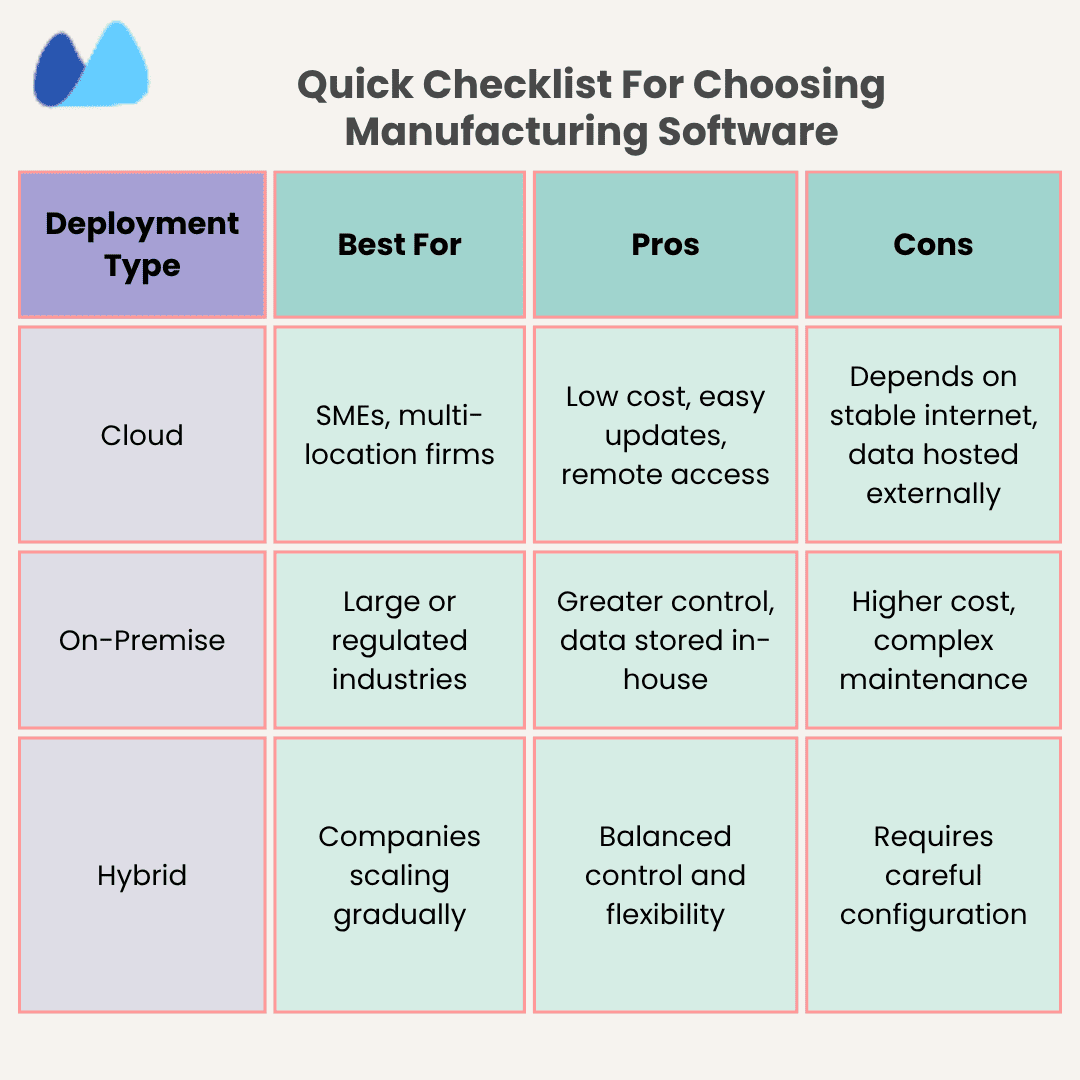
4. Deployment Options — Cloud, On-Premis, or Hybrid
Malaysian SMEs are increasingly adopting cloud ERP and MES solutions for lower upfront costs and easier maintenance.
5. Vendor & Support Network in Malaysia
Local support matters a lot. Always check whether your vendor has an active implementation partner or service center in Malaysia.
Good local support ensures:
- Fast response for setup or training issues
- Culturally aligned communication of Bahasa Malaysia or English documentation
Vendors like Syspro, HashMicro, Kladana, and local ERP integrators provide region-specific customization that global brands often lack.
6. Cost and ROI Considerations
Buying ERP or MES software isn’t just a cost. It’s an investment. To evaluate whether it’s worth it, calculate ROI based on your real savings and efficiency gains.
| Component | Example Value (MYR) | Notes |
| Upfront license/subscription | 25,000/year | SaaS or perpetual license |
| Implementation & training | 15,000 | Set up, user training, and data migration |
| Maintenance & support (annual) | 8,000 | Includes updates and local support |
| Total annual cost | 48,000 | − |
| Estimated efficiency gains | 15% higher output | Due to faster scheduling, fewer errors |
| Waste reduction savings | 20,000 | Better inventory and quality control |
| Labour cost savings | 10,000 | Reduced overtime and automation gains |
| Total annual savings | 30,000 | − |
| ROI formula | (B-A) ÷ A x 100 | Example ROI (30,00 — 48,000) ÷ 48,000×100 = 37.5% (Year 1) |
| Payback period | 1.5 years | ROI turns positive from year 2 onward as training cost stabilizes |
💡 Tip: Many Malaysian SMEs see ROI within 12–18 months once the system is fully adopted and production errors drop.
📘 Recommended Read: Curious how inventory control fits into Malaysia’s manufacturing ecosystem? Read Inventory Software Malaysia: A Complete System for Stock, Sales, and Growth before you scale to a full ERP.
Comparison of Top Malaysia / Regional Vendors & Solutions
When you start shortlisting business software vendors in Malaysia, you’ll find three main types of providers:
- Global ERP platforms,
- Regional players
- Local Malaysian vendors
1. Global ERP Platforms
If your company operates across multiple plants or exports internationally, you’ll likely evaluate global ERP systems like SAP Business One, Microsoft Dynamics, Infor, or Epicor.
These platforms are designed for large enterprises that need extensive financial control, deep manufacturing modules, and integration with corporate systems.
Why consider them:
- Provides the most comprehensive coverage, such as from production to costing and analytics
- Offer advanced modules for multi-entity operations and compliance with ISO or export regulations
- Built to scale. It is ideal if you run regional or global supply chains
Keep in mind:
- Implementation timelines can stretch to 6-12 months
- Costs are high (typically over MYR 200 K in the first year)
- Local SST formats, bilingual templates, or MYR currency setup often require customization
➡️ If your production is highly regulated (electronics, automotive, or aerospace), global ERP systems give you the depth and governance you need, though at a premium.
2. Regional ERP/MES providers
For most Malaysian SMEs, regional systems like SysprosubstantialMicro, or Kladana strike the right balance between functionality and cost.
They are specifically designed for Asian manufacturers and already include localization such as SST compliance, MYR reporting, and bilingual interfaces
Why consider them:
- Built specifically for manufacturing SMEs in Southeast Asia
- Offer substantial inventory, production, and quality modules
- Cloud deployment makes setup fast and affordable
📍Example: Syspro partners with Malaysian integrators like Cosmo Synergy to deliver MES-grade visibility. HashMicro focuses on flexibility, letting you choose only the modules you need.
From Shop Floor to Balance Sheet — All in One System
📌 Kladana offers a lightweight ERP+MES layer that connects inventory, production, and costing in one system. It also acts as a data-orchestration bridge between shop floor tools and the financial system, reducing the need for separate middleware.
Keep in mind:
- Some advanced analytics or multi-factory coordination may need add-ons
- Integration depth with PLCs or IoT systems varies across providers
➡️ For growing mid-sized manufacturers, regional vendors offer the fastest path to digitization with the least disruption.
3. Local Malaysian Vendors & Integrators
If you’re a small manufacturer or prefer direct local support, consider Malaysian-based ERP vendors like AutoCount, SQL Account, or regional system integrators as worth exploring. They excel in simplicity, quick training, and compliance with Malaysian tax and reporting rules.
Why consider them:
- Ready-to-use SST and MYR built-in templates
- Local after-sales and bilingual support
- Lower upfront investment and faster setup (often within 1–2 months)
Keep in mind:
- Limited scalability beyond a single plant or warehouse
- Advanced modules like BOM versioning or OEE tracking may be missing
➡️ These systems work well for small factories needing accounting, inventory, and light production functions without the complexity of large ERP suites.
Which type fits you best:
- SME manufacturers: Opt for cloud-based ERP solutions in Malaysia. You can also look for other options like Kladana or HashMicro for fast deployment, scalability, and affordability.
- Mid-sized firms: Syspro suits best for growing manufacturers needing advanced production planning and costing.
- Large enterprises: SAP or Microsoft Dynamics 365 deliver enterprise-grade scalability, though with a higher investment.
Implementation Best Practices & Pitfalls
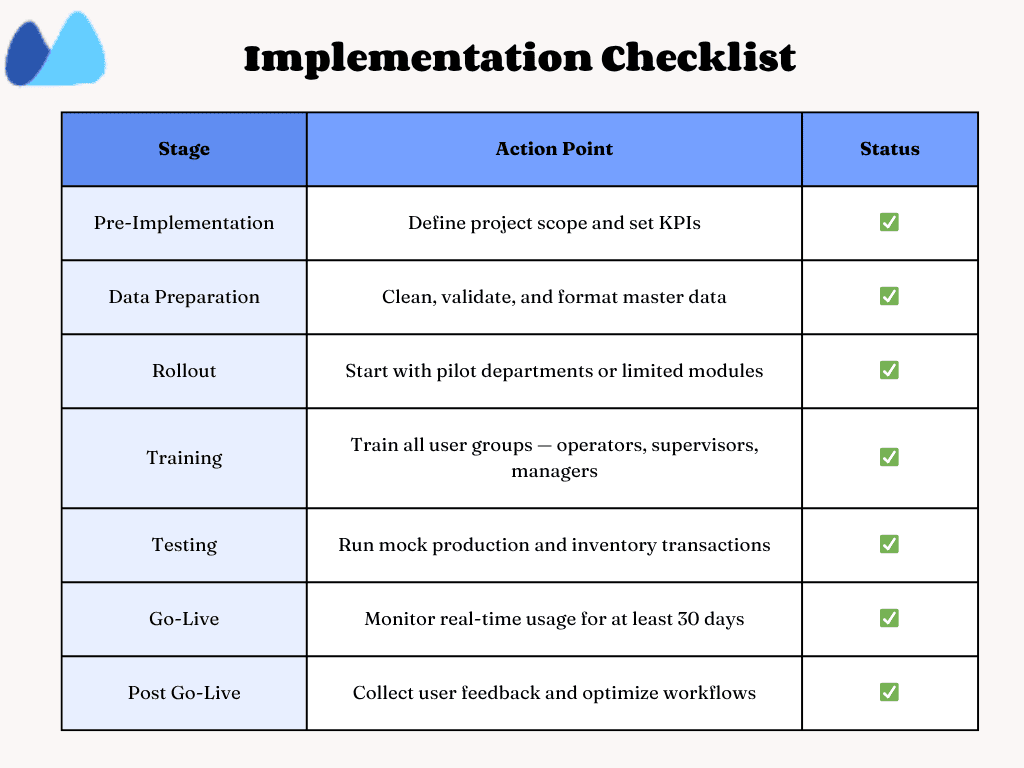
Choosing the right manufacturing software in Malaysia is only half the job. The real results come when you implement it correctly without disrupting daily operations. Many manufacturers rush through rollout, skip data cleaning, or fail to train teams properly, which delays ROI.
Here’s how you can plan a smooth, successful implementation from day one.
1. Start with a Phased Rollout
Instead of going live with modules at once, start small and expand gradually. Begin with high-impact areas such as inventory and production tracking, then move to costing, maintenance, and analytics.
Why it works:
- Lower risk of system errors
- Easier change management
- Better learning curve for your team
Many Malaysian SMEs use cloud ERP first to automate inventory and BOM management before adding advanced modules like shop-floor control or Quality control.
2. Clean and Standardize Your Data Early
Before migration, review your existing spreadsheets, supplier lists, and part codes. Make sure data is clean, accurate, and follows a standard naming format.
Checklist before import:
- Remove duplicate or outdated entries
- Unify product codes and units
- Validate opening balances and stock levels
3. Involve Operators and Team Leads
ERP and MES systems work best when everyone uses them consistently, not just management. It involves supervisors, operators, and maintenance teams early during demo and training sessions.
Benefits:
- Higher adoption rate
- Fewer user errors after go-live
- Better feedback on workflow design
4. Balance Customization and Standard Features
Many manufacturers attempt to customize every screen and report to replicate the old manual system, which delays implementation and increases costs.
Instead, use the system’s default workflow first, then add customizations only where necessary. In this way, you will have 80% standard features and 20% essential customization.
5. Test, Review, and Support after Go-Live
After implementation, plan at least 4-6 weeks of pilot testing. Run mock production orders, track inventory, and verify reports before going fully live.
Post go-live, ensure your team has access to:
- Quick issue-resolution channel
- User manuals and video tutorials
- Periodic system audits to ensure consistency
Common pitfalls to avoid:
- Rushing implementation without pilot runs
- Ignoring operator training and feedback
- Poor data migration quality
- Excessive customization
- Lack of ongoing vendor support
Malaysian Case Studies & Success Stories
When you decide to digitize your factory, you’re joining a growing wave of Malaysian manufacturers investing in ERP, MES, and automation systems to stay competitive. Many firms have already seen measurable improvements in productivity, cost control, and data accuracy after implementing manufacturing software in Malaysia.
Below are some examples of how local companies used ERP and MES to achieve tangible results
Case Study 1: Comet, Penang — Doubling Production with Cloud MES
In Penang’s precision manufacturing sector, Comet faced a challenge familiar to many Malaysian factories: manual spreadsheets, disconnected systems, and limited visibility on the shop floor. The team wanted to scale output without adding more administrative layers or manual data entry.
To solve this, Comet adopted a cloud-based system that connected five existing IT systems into one digital network. Once implemented, their production tracking, equipment status, and quality checks were all managed through a centralized dashboard. It helped them in production output, performance visibility, and improved coordination.
Case Study 2: Streamline Operations in a Malaysian F& B Factory
A food and beverage manufacturer in Malaysia was struggling to manage procurement, costing, and inventory manually. The lack of system integration causes reporting delays and makes it hard to track real production expenses.
After adopting an integrated ERP solution, the company gained real-time visibility into material use and automated its costing and procurement processes.
Key improvements:
- Monthly financial closing completed in half the time
- Accurate tracking of ingredient costs and batch records
- Clear visibility of stock and spending across departments
ROI & Business Justification for Malaysia
When you invest in manufacturing software in Malaysia, you’re not just buying a tool, but you’re also investing in efficiency, accuracy, and long-term competitiveness.
ROI helps you understand both tangible and intangible benefits from reduced downtime and waste to faster reporting and happier customers.
1. Typical Cost Components
Before calculating ROI, it’s essential to know what you’ll spend upfront and annually. Costs can vary depending on whether your software is cloud-based or on-premise.
| Cost Component | Example Estimated Range (MYR) | Description |
| License/subscription | 15,000–50,0000/year | Based on modules, users, and deployment type |
| Implementation & training | 10,000–30,000 | Setup, customization, data migration, and onboarding |
| Maintenance & support | 5,000–15,000/year | Vendor assistance, upgrades, and troubleshooting |
| Hardware/infrastructure | 10,000–25,000 | Servers, local storage, or backup systems |
| Total 1st year investment | 30,000–90,000 above | For most Malaysian SMEs or mid-tier manufacturers |
2. Benefit Metrics You Should Track
To evaluate ROI effectively, you need measurable performance indicators. These reflect efficiency and cost savings that directly impact your bottom line.
| Benefit Metric | How It Helps You | Typical Improvement |
| Inventory accuracy | Prevent stockouts and over-purchasing | + 25–40% accuracy gain |
| Production efficiency | Improves resource utilization and throughput | +15–30% improvement |
| Order-to-delivery time | Faster scheduling and dispatch | −20–35% reduction |
| Waste reduction | Reduce rework, scrap, and idle time | −10–25% waste savings |
| Admin & reporting time | Reduces manual data entry and delays | −40–60% faster closing cycles |
3. ROI Calculation Example
| Category | Amount (MYR) | Notes |
| Total нear 1 шnvestment | 60,000 | Includes license, setup, and support |
| Annual cost savings | 85,000 | Based on improved productivity, fewer errors, and reduced waste |
| ROI formula | (B-A) ÷ A x 100 | — |
| Calculated ROI | (85,000 − 60,000) ÷ 60,000×100 = 41.6% | Positive ROI in first year |
| Payback period | 10–12 months | Typical for Malaysian SMEs adopting cloud ERP |
Future Trends for Manufacturing Software in Malaysia
As Malaysia advances its industry, manufacturing software is evolving from traditional ERP tools to smart, connected systems. Here are the primary technology shifts that will shape your factory.
1. Predictive Analytics and AI
AI and analytics help you anticipate machine breakdowns, demand fluctuations, and quality issues before they occur.
It allows better planning, fewer stoppages, and lower costs. Local R& D centers are also developing AI models for production optimization and energy efficiency, making these technologies more accessible to SMEs.
2. Digital Twins, Ege Computing, and Smart Factories
Digital twin technology lets you create a virtual model of your equipment or production line to test improvements before applying them on the floor.
When combined with edge computing and Industrial IoT, your systems can process data directly at the machine level for faster, real-time control. Meanwhile, robotic automation continues to grow in assembly, packaging, and inspection, and improves precision.
3. Cloud-Native and Microservices ERP systems
The new generation of ERP and MES software runs on cloud-native, modular architectures. This means you can add or remove features easily, scale quickly, and integrate with other business apps without significant rework.
Cloud adoption in Malaysia continues to rise as manufacturers look for flexible, cost-efficient systems that update automatically and connect seamlessly with IoT, CRM, and analytics tools.
Actionable Roadmap & Next Steps
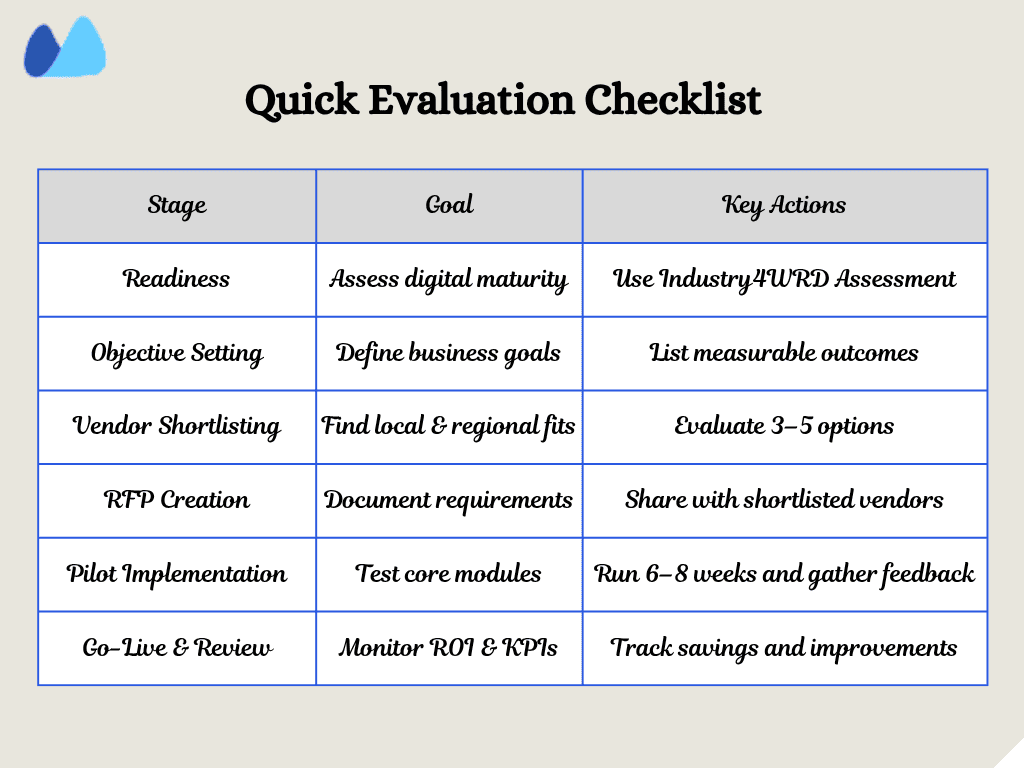
Once you’ve evaluated the right manufacturing software for your business, the next step is to move from research to rollout.
1. Assess Your Readiness
Start by reviewing your current setup.
Ask yourself:
- Are you still using manual or disconnected systems?
- Which areas? Which areas, such as production, costing, or reporting, cause the most delays?
2. Set Clear Objectives
Define what success looks like in the first year.
Examples:
- Reduce downtime by 15%
- Improve order fulfillment time
- Increase inventory accuracy
3. Shortlist the Right Vendors
When comparing options, focus on:
- Localization: SST compliance, MYR reporting, bilingual formats
- Scalability: Ability to support multi-plant growth
- Deployment: Cloud vs on-premise, depending on your IT setup
- Support: Active presence or partner network in Malaysia
4. Prepare a Simple RFP
Your RFP (Request For Proposal) should outline:
- Key business goals and modules needed
- Integration needs (IoT, accounting, CRM)
- Budget and timeline expectations
- Support and training requirements
5. Run a Pilot First
Before going full-scale, test the system in one department or product line for 6-8 weeks. Track how sound data syncs between teams and whether reports match real performance.
🚀 Scale Production Your Way With Kladana
Cloud, On-premise, or hybrid — Your operations stay synced and visible in real time
Frequently Asked Questions on Manufacturing Software in Malaysia
What is manufacturing software, and how does it differ from ERP or MES?
Manufacturing software is a digital system that helps you manage production, inventory, and quality processes.
ERP covers company-wide operations like finance, purchasing, and HR. MES focuses specifically on the shop floor tracking machines, operators, and real-time output.
In Malaysia, many modern systems combine ERP and MES features, allowing you to plan, execute, and monitor everything on one platform.
Why do Malaysian manufacturers need modern software?
The Malaysian manufacturing sector is becoming more competitive under Industry 4.0. A modern ERP or MES helps you automate production planning, reduce waste, meet SST and ISO compliance, and make faster business decisions.
What deployment models are standard in Malaysia (cloud/on-premise)?
Both are available.
- Cloud ERP Malaysia options are becoming popular among SMEs because they cost less upfront and are easier to maintain
- On-premise systems still appeal to large manufacturers with strict data policies. Some companies use hybrid models, running sensitive modules on local servers and others in the cloud
Which software vendors or integrators are active in Malaysia?
You’ll find a mix of global, regional, and local providers
- Global
- Regional
- Local
How much does manufacturing software cost in Malaysia?
Costs vary depending on company size, modules, and deployment:
- Small SME (Cloud ERP)
- Mid-tier manufacturer
- Large enterprise (on-premise)
How long does the implementation typically take?
Most SME ERP implementations in Malaysia take 2–4 months for core modules. Large and multi-site rollouts can take 6–12 months. The timelines depend on data preparation, team training, and whether you start with a pilot rollout or full deployment.
What are common pitfalls in Malaysian deployments?
The most frequent issues include:
- Poor data migration
- Over-customization that slows go-live
- Limited operator training
- Lack of post-launch support
Can manufacturing software integrate with existing plant systems (SCADA, PLCs)?
Yes, especially if you choose a MES or ERP platform with open APIs or IoT integration. Many Malaysian manufacturers connect their ERP with SCADA or PLC systems to capture live machine data.
What ROI can a Malaysian manufacturer realistically expect?
ROI depends on your starting point, but most companies see benefits within 12–18 months:
- 15–30% faster production
- 10–25% less waste and rework
- 20–40% reduction in manual data entry and reporting time
What future trends will shape manufacturing software choices in Malaysia?
The next wave includes:
- Predictive analytics for maintenance and forecasting
- Smart factory and IoT integration
- AI-assisted scheduling and quality checks
- Cloud-native, modular ERP, etc.
List of Resources
- Mordor Intelligence: Malaysia ICT Market Analysis by Mordor Intelligence Source
- Market Data Forecast: Asia Pacific Software Market Growth
Read‑alikes
CRM in Manufacturing Industry: Driving Efficiency, Visibility & Growth
How to Scale with Contract Manufacturing: a Complete Guide for SMEs and Startups
Managing Production in a Small Manufacturing Company: Planning, Control, and Profit Calculation
QMS for Manufacturing: How a Quality Management System Improves Efficiency